
Care-First saves Alberta drivers $297. Riders get a 37–79% premium hike.
Starting November 1, renewal notices will show what the province’s “88% of vehicles save” headlines left out: every motorcycle rating profile goes up, some riders are already being dropped by their insurer, and the right to sue an at-fault driver disappears with the old system.
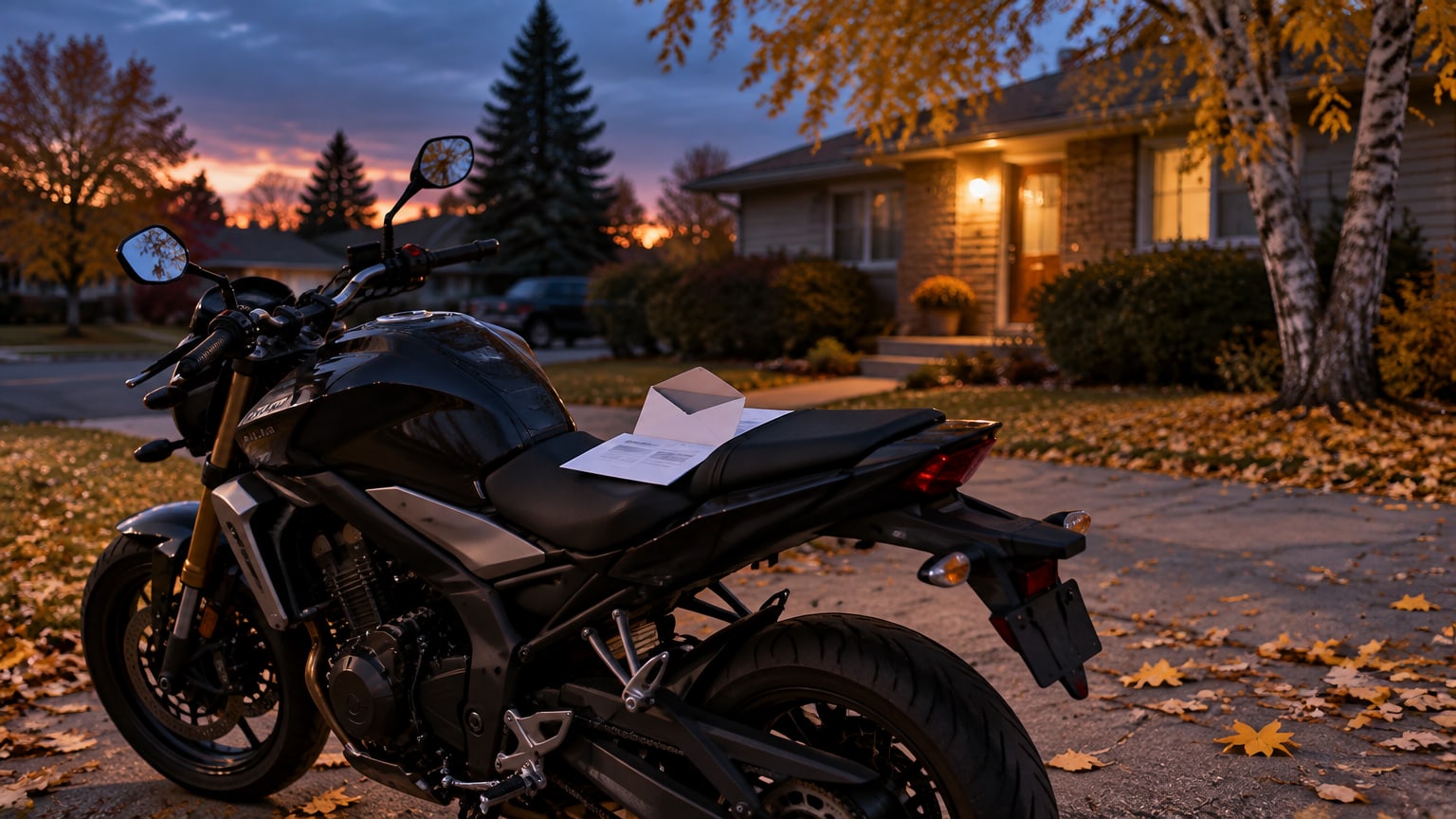
On November 1, Alberta insurers begin mailing renewal notices priced under Care-First, the no-fault-style insurance system that replaces the province’s court-based model on January 1, 2027. For most households the envelope carries good news: the Automobile Insurance Rate Board (AIRB) projects an average cut of $297, or 13.7%, for private passenger vehicles, with 88% of Alberta’s 3.1 million insured vehicles paying less. If you ride a motorcycle, your notice says the opposite. All three of the AIRB’s motorcycle rating profiles rise by at least 37%, the steepest increase of any vehicle class in the province, and the regulator’s own filings put the average motorcycle increase at 100.1%, or $445 per policy.
The headlines so far have led with the savings. The Edmonton Journal reported that 47% of vehicles save $300 or more. The province’s press releases talk about “the highest level of benefits in Canada.” Behind the savings is a transfer: injury costs are moving off car policies and onto the policies of the people most likely to get hurt, and riders are paying the difference with both their premiums and their legal rights.
Care-First premium change by AIRB rating profile
Approved insurer filings, effective January 1, 2027. Cars save; every motorcycle profile pays more.
Young drivers get the biggest cuts because they carried the heaviest lawsuit-risk load under the old system. Motorcycles get no cut at all, because riders were never paying for lawsuit risk in the first place. They were paying for the bike. Now they are paying for what happens to their own bodies in a crash.
Why bikes rise when everyone else saves
Under the court-based system, a badly injured rider sued the at-fault driver. The compensation came from the at-fault driver’s insurer, and the cost of those payouts, plus the lawyers on both sides, was spread through the bodily-injury portion of every car policy in the province. A rider’s own premium mainly covered the motorcycle itself, with property damage, theft, and a modest slice of injury coverage. Riders are involved in relatively few collisions, and bikes rarely injure anyone else, so that slice stayed thin. AIRB’s profile report notes the average Alberta motorcycle premium was $412 in 2025, and had been falling for years once adjusted for inflation.
Care-First breaks that arrangement. Injury claims now go through the injured person’s own insurer, with unlimited medical and rehabilitation coverage for eligible treatment, income replacement up to $125,000 a year until retirement, and a permanent-impairment benefit up to $295,000. Motorcycle collisions are far more likely to produce serious injuries than car collisions, and the premiums rise to cover them.
Where the motorcycle increase comes from
The chain that turns a system-wide savings story into a rider-specific bill.
An injured rider sues the at-fault driver; the at-fault driver’s insurer pays. Lawsuit and legal costs are baked into the bodily-injury premiums of every car and truck in Alberta.
Expanded benefits come with it: unlimited eligible treatment, income replacement to $125,000 a year, impairment benefits to $295,000. Someone’s premium has to carry that expected cost.
Cars lose their lawsuit-cost load, so 88% of vehicles get a cut. Motorcycle collisions are disproportionately severe, so the new injury-benefit cost lands heaviest on bike policies. The AIRB: “the damage which can be done to you is now the most significant rating variable.”
And riders who once recovered full damages from an at-fault driver now claim against their own insurer instead, with lawsuits reserved for at-fault drivers convicted of serious offences.
Oliver Wyman’s March report, prepared for the AIRB, projected “direct premium increases of approximately $367 for motorcycles,” lifting the required average motorcycle premium for full coverage to $920.24, while estimating savings of roughly $337 for commercial vehicles and hundreds of dollars per year for cars. The filings insurers later submitted, and the AIRB approved, came in close to that forecast.
What riders get back, and what they lose
The province’s case is that riders are not just paying more: they are buying into the richest accident-benefits package in Canada, and the benefit numbers back it up. If you are hurt in 2027, your own insurer pays, treatment is not capped for eligible care, and income replacement runs up to $125,000 a year until retirement, where the old accident-benefits floor was far lower. There is no lawsuit to finance while you recover, and the government says benefits start within weeks rather than years.
An injured Alberta rider, before and after January 1, 2027
The benefits are bigger; the legal door is mostly closed.
Court-based system (until Dec 31, 2026)
- Who pays your injury: you sue the at-fault driver; their insurer settles or loses in court.
- What you can recover: full damages, including pain and suffering and future income loss, if you prove fault.
- Cost of recovery: years of litigation is common; the province’s own materials say lawyers take 30–40% of settlements.
- Meanwhile: your own policy’s accident benefits are comparatively modest.
- Premium: average motorcycle premium $412 in 2025, trending down.
Care-First (from Jan 1, 2027)
- Who pays your injury: your own insurer, under provincially set schedules, regardless of fault.
- What you can recover: unlimited eligible treatment; income replacement to $125,000/yr until retirement; $295,000 maximum permanent-impairment benefit; $600,000 spousal support on death.
- Right to sue: gone in most cases. You can sue only if the at-fault driver is convicted of certain serious offences, such as dangerous operation, impaired driving or fleeing police.
- Speed: benefits are meant to begin within weeks, with disputes handled outside court.
- Premium: standard profiles rise 37.7–79.4%; filings average +$445 per motorcycle.
The rider’s side of the Care-First trade
| Item | Court-based (today) | Care-First (Jan 1, 2027) |
|---|---|---|
| Typical premium (standard profiles) | $875–$1,426 per year | About $1,570–$1,964 (+37.7% to +79.4%) |
| Medical and rehab coverage | Schedule limits on your own policy | Unlimited for eligible treatment |
| Income replacement | Limited accident benefits | Up to $125,000/yr until retirement |
| Permanent impairment | Through lawsuit or limited benefits | Benefit up to $295,000 |
| Sue an at-fault driver | Yes in most cases (minor-injury cap excepted) | Only if the driver is convicted of certain serious offences |
| Time to benefits | Months to years if litigated | Targeted within weeks |
| Renewal notices | As usual | Care-First pricing from November 1, 2026 |
Some riders are not getting a renewal at all
In March, the Alberta Motor Association began sending non-renewal letters to a slice of its motorcycle customers, including riders with clean records. AMA told CTV News Edmonton the change “affects a very small number of motorists who represent a significantly higher injury risk,” less than two per cent of its policies, aimed at “less experienced riders, individuals with traffic convictions or prior claims, and/or those operating high-performance motorcycles.”
The province’s Office of Treasury Board and Finance insists AMA assured it the decision “is not associated with the transition to Care-First.” The letters themselves cite the new legislation as the reason. In one r/alberta thread, a rider with no claims, three other vehicles and his home insurance at AMA described the notice he received; the posts that followed include a father whose son’s 900cc cruiser was dropped while his own 750cc was renewed, and a wife whose husband, a rider in his 40s on a 650cc Kawasaki whose only claim was a theft, got the same letter.
CTV News Edmonton said AMA was the only insurer it could confirm was non-renewing motorcycle policies ahead of the switch. But the industry comes into the transition weakened: Alberta’s insurers lost a combined $1.2 billion in 2024, premiums rose 8.7% last year, and two insurers already left the private passenger market in 2025. Brandon Pritchard of Edmonton’s After Dark Motorcycles told CTV one customer dodged the non-renewal only to see his premium jump by more than $1,000, and switched companies. “Is it just going to be that you can’t insure a motorcycle in Alberta anymore?” he asked. “I hate to say it, but people will just resort to riding with no insurance.”
In mid-September the AIRB stopped accepting rate filings that would increase consumer premiums until it issues new guidelines later this year, which caps further Care-First-driven hikes for now. Nor has the regulator announced any backstop for riders who cannot find an insurer willing to write their policy at any price.
The renewal notice is the decision point
Every Alberta motorcycle policy that takes effect on or after January 1, 2027 will carry Care-First pricing, and notices start arriving November 1. A renewal in March 2027 reflects the same system. If you ride in Alberta, the next three months are the window to shop before Care-First pricing takes effect.
The two branches of a Care-First renewal
Check the size against the AIRB profiles: +37% to +80% is the published range for standard riders. Then get two or three competing quotes through brokers who write motorcycle business; insurers price the new injury-benefit cost differently, and the spread between them will matter more than ever. Review your coverages while you are at it: deductibles, comprehensive for winter storage, and any add-ons you do not use.
Start replacement shopping the day it arrives, well before your expiry date: Alberta requires insurance to register and ride, and a lapse leaves you exposed. Ask the insurer for the reason in writing. If you cannot find coverage at any price, raise the availability problem with your broker and with the AIRB, which oversees the market even if it did not order the underwriting decision.
From January 1, an injury claim runs through your own insurer, not a lawsuit against the at-fault driver (except where that driver is convicted of serious offences such as impaired driving). Save your policy documents, learn the benefit schedules, and if you carry a car as well, check how your combined coverage treats household members as passengers.
Mike Cooper, who has ridden motorcycles in Alberta for more than 45 years, put the rider’s view of the risk math to CTV this way: “Most of the accidents that I know of were actually caused by car drivers.” Under Care-First, when one of those accidents happens, it is the rider’s own insurer writing the cheque, and the rider’s own premium that paid for it. The government calls the system fairer, faster, and cheaper, and for the 88% of vehicles paying less, it is. Riders sit outside that bargain: this winter, roughly every motorcycle in the province gets a renewal notice with a higher bill attached.
Sources
- AIRB, Care-First Premium Impacts, September 8, 2026, with the Care-First Premium Impact by Profile and Care-First Consumer Premium Impact reports.
- Insurance Business Magazine, Care-First pricing hits Alberta renewal notices from November 1, October 4, 2026.
- Edmonton Journal, Alberta’s new insurance regime will see savings for 88 per cent of vehicles: rate board, September 10, 2026.
- Government of Alberta, Care-First auto insurance (benefit amounts and right-to-sue rules).
- CTV News Edmonton, AMA stopping some motorcycle insurance ahead of new provincial rules, March 23, 2026.
- Insurance Portal, Premium savings expected under care-first program in Alberta (Oliver Wyman actuarial costing figures), April 6, 2026.
- Insurance Bureau of Canada, news release on AIRB reports, September 9, 2026.
- Rider non-renewal reports: r/alberta thread, March 20, 2026.
- Insurance Business Magazine, Care-First savings bigger than expected, AIRB confirms, September 10, 2026 (market losses, insurer exits).
Figures are AIRB-approved filing averages and standardized rating profiles as of September 8, 2026. AIRB staff have cautioned that projections are not guarantees; individual renewals depend on insurer, coverage, record and vehicle. Profile dollar values marked “about” were read from the AIRB’s published chart.