
Lane position is one of the first practical skills Ontario motorcycle learners must master for the M1/M2 road tests and everyday riding. Whether you’re navigating downtown Toronto traffic or cruising the 400-series highways, where you place your motorcycle within a lane directly affects your safety, visibility, and control.
This guide is based on the Ontario Official Motorcycle Handbook, the M1 practice test, and real-world riding conditions across the GTA, Highway 401, 403, and QEW. When we talk about lane position, we mean where you place your bike within a single lane—the left tire track, right tire track, or centre—not which lane you choose overall.
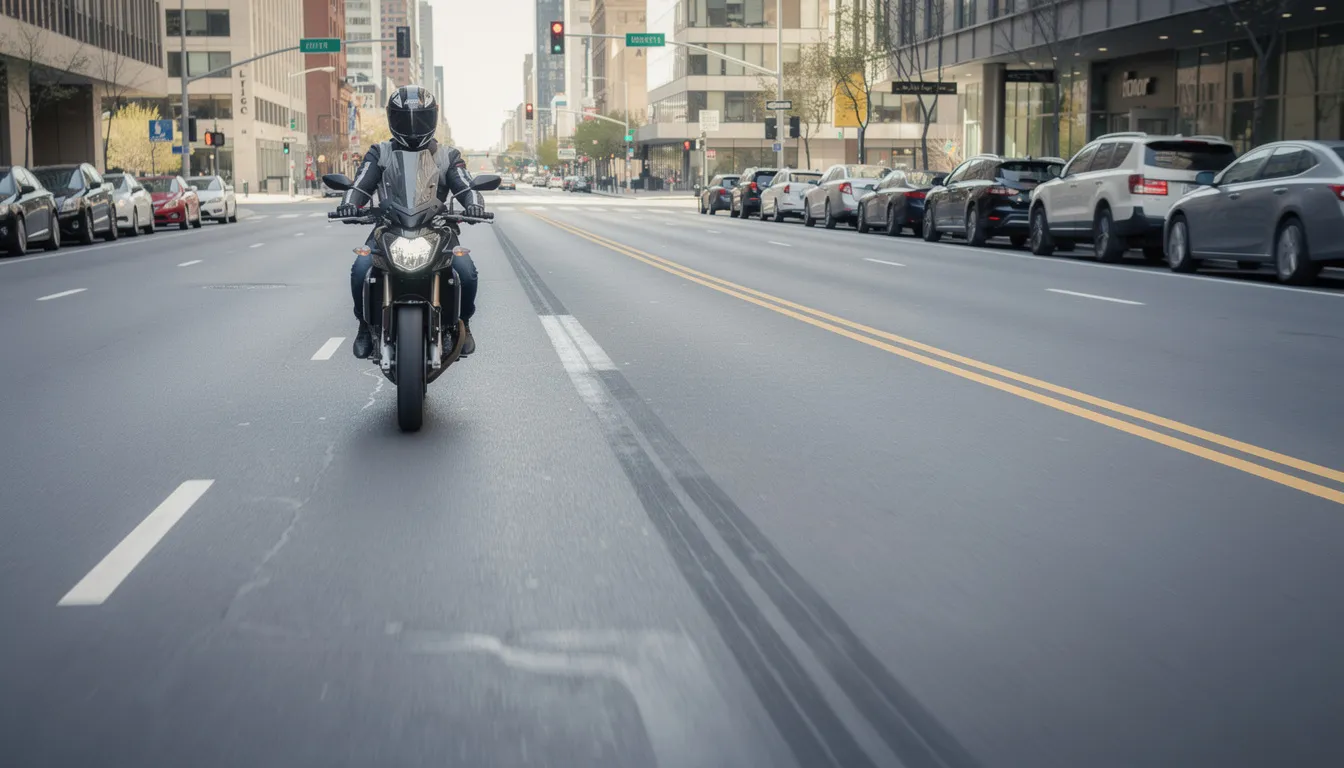
You’ll get a quick answer on the correct lane position for Ontario riders, followed by detailed breakdowns for city traffic, highways, right and left turns, lane sharing scenarios, and common mistakes that trip up new riders.
Here’s how the three lane positions compare in prose form: the left tire track runs along the left side of your lane where car tires roll, offering good visibility and escape space to the right. The right tire track mirrors this on the right side of the lane, providing protection from oncoming traffic and median barriers. The centre of the lane sits between these tracks—and it’s where oil, coolant, and other vehicle fluids accumulate, making it the slipperiest and least desirable position for motorcycles.
Fast Answer: Best Motorcycle Lane Position in Ontario
On most Ontario roads, riders should use a blocking position in the left or right tire track, slightly off the lane centre, not the oily centre strip.
Here’s the default rule of thumb:
In the curb lane (right lane), use the left tire track—ride slightly left of centre
In the passing lane (left lane), use the right tire track—ride slightly right of centre
On roads with three or more lanes, the centre lane is least ideal; if you must use it, stay left of centre
This blocking position is recommended in the Ontario Motorcycle Handbook because it maximizes your visibility to other drivers, provides better traction on cleaner pavement, creates space from other vehicles, and discourages drivers from trying to squeeze past or share the same lane.
Limited-speed motorcycles and mopeds that cannot maintain the posted speed limit must move closer to the right edge of the roadway. However, these riders should still think in terms of tire tracks and use a blocking position when lanes are too narrow for vehicles to pass safely.
Understanding Tire Tracks and Blocking Position
Tire tracks are the paths left by car tires as they travel down the roadway. Every lane has two distinct tracks—the left and right tire tracks—with an oily, slippery strip running down the centre, where fluids drip from engines and transmissions.
The blocking position concept in Ontario means riding slightly left of centre in a curb lane or slightly right of centre in a passing lane. This deliberate positioning makes it harder for cars to squeeze beside you in the same lane and signals to experienced drivers that you’re claiming your full lane space.
Riding in the proper blocking position improves:
Traction: The tire tracks are cleaner pavement with less accumulated oil, reducing your risk of losing grip during braking or cornering
Visibility: You can see farther past the vehicle ahead and be seen more easily in the mirrors of drivers in front of you
Space cushion: You maintain more room to swerve or brake in an emergency, giving you escape options on either side
Ontario examiners look for consistent, deliberate blocking positions during M2 and M road tests in cities like Toronto, Mississauga, Ottawa, and London. Wandering between positions or riding dead-centre will cost you points.
Think of it this way: the left tire track puts you in a commanding position in the curb lane, visible and protected. The right tire track does the same in the passing lane. The centre strip belongs to fluid drips from cars, not to your motorcycle.
Limited-Speed Motorcycles and Mopeds in Ontario
Ontario recognizes limited-speed motorcycles and mopeds that may not maintain the 60–80 km/h posted limits common on city arterials and rural highways. These vehicles require slightly different lane positioning strategies.
The general rule works like this: if your vehicle can keep up with traffic flow, use the normal blocking position in the appropriate tire track. If you cannot maintain traffic speed, ride as close as safely possible to the right curb or edge of the roadway to allow faster traffic to pass.
Even when riding near the edge, limited-speed riders should still:
Avoid loose gravel, sewer grates, and debris that accumulates near the curb
Keep a visible gap from parked cars to avoid a door opening into your path
Scan constantly for side streets and driveways, especially common in Ontario suburbs, where right turns across your path are frequent
When lanes are too narrow for safe passing, limited-speed riders should move into a blocking position to prevent drivers from squeezing past in the same lane. This is especially important on roads where the lane width doesn’t allow safe side-by-side positioning.
On roads signed 80 km/h or higher, some mopeds and very low-powered scooters may not be legally permitted. If you’re unsure, consult the Ontario Highway Traffic Act and local bylaws before riding these routes.
Consider these Ontario scenarios:
Downtown Toronto side streets: Narrow lanes and frequent parking mean staying in a blocking position even at lower speeds
Rural two-lane roads near Guelph or Kingston: Move right to let faster traffic pass on straights, but claim your lane through curves
Suburban arterials like Hurontario Street in Mississauga: Use the blocking position in the curb lane to protect against vehicles exiting plazas and parking lots
Wrong Lane Positions and the Slippery Centre
Many new riders assume the middle of the lane is the safest place to ride. The Ontario handbook specifically discourages this position.
The centre of the lane is often the worst choice because:
Oil and fluid leaks from cars and trucks accumulate there throughout the day
The centre strip becomes especially slick during the first minutes of rainfall on Ontario roads after a dry spell—water mixes with oil to create a dangerously slippery surface
Reduced traction means longer stopping distances and less control during emergency braking or cornering
Riding dead-centre also reduces your visibility by tucking your motorcycle directly behind the vehicle ahead. This is especially problematic behind SUVs and pickup trucks common on Ontario highways—you can’t see traffic signals, brake lights, or hazards until they’re right in front of you.
Consider this example: riding in the centre behind a delivery van on King Street in Toronto versus riding to the left of the tire track. In the blocking position, you can see crosswalks, pedestrians, and side streets several seconds earlier. Behind the van in the centre, you’re riding blind.
The message is simple: avoid the centre of the lane. It offers less traction, worse visibility, and no blocking advantage.
Lane Position in Different Ontario Lanes
Lane position changes depending on whether you’re in the curb lane, passing lane, or centre lane on Ontario multi-lane roads like Highway 401 or busy city streets.
Curb Lane (Right Lane)
In the curb lane, position yourself slightly left of centre in the left tire track. This blocking position:
Improves sightlines past vehicles ahead so you can see what’s coming
Protects against cars emerging from driveways or a door opening from curbside parking
Discourages drivers from trying to pass you within the same lane
This position works well on city routes like Lakeshore Boulevard or Bloor Street, where parking is common, and drivers frequently pull out without shoulder-checking for motorcycles.
Passing Lane (Left Lane)
In the passing lane, position yourself slightly right of centre in the right tire track. This blocking position:
Keeps you away from oncoming traffic on undivided highways
Creates distance from the median barrier on 400-series highways and freeways
Discourages vehicles from trying to share your lane from the right side
The right tire track in the passing lane also gives you a clear escape path to the right if a vehicle suddenly slows or stops ahead.
Centre Lane (Three or More Lanes)
On roads with three or more lanes, Ontario handbooks suggest avoiding the centre lane when possible because it doesn’t offer a strong blocking position—you have traffic on both sides.
If you must use the centre lane:
Ride left of centre to make yourself more visible
Maintain extra awareness of vehicles in both adjacent lanes
Be ready to change lanes if traffic begins to compress around you
The centre lane forces you to manage threats from multiple directions, which is why the curb lane or passing lane typically offers better positioning options.
Right Turns: Same-Width and Wider Curb Lanes
Intersection design in Ontario varies considerably between downtown grids and suburban arterials. Lane width directly affects your right-turn lane position strategy.
Right Turn in a Same-Size Lane
When approaching a normal-width curb lane for a right turn:
Stay in your standard blocking position in the left tire track during approach
Some riders angle their motorcycle slightly across the lane to increase visibility to following traffic and make it harder for cars to sneak up on the right
After completing the turn, smoothly return to the best blocking position for the new lane
Signal early and check your mirror to ensure the following drivers see your intentions
Right Turn in a Wider Lane
At major intersections like Highway 7 & McCowan or Eglinton & Don Mills, lanes often widen as you approach:
As the lane opens up, move from the left tire track to the right tire track
This prevents cars from trying to pass on your right inside the same lane
Angle your motorcycle slightly to cover more of the wider part of the lane
Signal clearly and maintain your position through the turn
Upon finishing the turn, perform a shoulder check and move back to the normal blocking position in the left tire track
Ontario road test examiners look for decisive lane placement when lanes widen at intersections. Wandering in the middle or allowing vehicles to pull alongside will cost you marks.
Left Turns: From Curb Lane and Passing Lane
Left turns are high-risk maneuvers for motorcycles in Ontario, with many collisions occurring at urban intersections. Your lane position through the entire turn sequence is critical for visibility and safety.
Left Turn from Curb Lane to Curb Lane
This applies where your left-turn lane is the leftmost of the curb lanes as marked:
Maintain your blocking position in the left tire track of the turning lane during the approach
When waiting at the stop line, stay in gear with your left foot down and watch oncoming traffic
Keep your brake light illuminated so following drivers know you’re stopped
As you execute the turn, maintain your relative position in the left tire track
Arc smoothly into the receiving curb lane without drifting into adjacent lanes or the path of oncoming traffic, completing their own left turn
Left Turn from Passing Lane to Passing Lane
For dedicated left-turn lanes in the passing-lane position:
Use the right tire track as your blocking position during approach and while waiting
Maintain that right-of-centre track throughout the turn
Land in the corresponding passing lane on the new road
This pattern is common at major signalized intersections on 4–6 lane roads in Ontario suburbs and highway off-ramps
Throughout any left turn, watch for:
Vehicles turning left across your path that misjudge your speed
Drivers running late at complex intersections like those in downtown Toronto or Ottawa
Pedestrians entering crosswalks as your signal changes
A small movement in your lane position during a left turn can mean the difference between a safe maneuver and a collision with oncoming traffic.
Changing Lanes Safely in Ontario Traffic
Ontario’s dense traffic—Highway 401 through Toronto, Highway 417 in Ottawa, the DVP during rush hour—makes precise lane changes essential. Your lane position matters throughout the entire maneuver.
Follow this repeatable sequence for safe lane changes:
Avoid unnecessary weaving; stay in one lane as much as practical to reduce exposure
Check your mirror for vehicles behind and beside you
Signal your intention early so other drivers can anticipate your move
Check your mirror again to confirm the gap is still clear
Perform a shoulder check to clear the blind spot that mirrors can’t show you
On multi-lane roads, verify far lanes too—another vehicle may be targeting the same gap from the opposite direction
As you change lanes, move from the blocking position in your current lane to the correct blocking position in the new lane. If you’re moving from the curb lane to the passing lane, shift from the left tire track to the right tire track as you complete the lane change.
Common Ontario scenarios to rehearse:
Moving from the right lane to the left to pass a slow truck on Highway 401
Shifting from the centre lane to the curb lane to exit in time on the 403 or Gardiner Expressway
Merging from an on-ramp into freeway traffic, targeting a gap, and establishing your blocking position immediately
Think of this sequence as a mental checklist before every lane change on your road test and beyond.
Lane Sharing, Lane Splitting, and Ontario Law
Understanding the difference between lane sharing and lane splitting is essential for Ontario riders.
Lane sharing: A car or another motorcycle using your lane beside you
Lane splitting: Riding along the line between lanes to filter through traffic
Here’s what Ontario expects from motorcyclists:
You are entitled to a full lane, just like a car
Use your blocking position to discourage other vehicles from sharing your lane
If a vehicle attempts to squeeze past, maintain your position rather than yielding space that invites further encroachment
Riding side by side with another motorcycle in the same lane reduces escape options and is generally discouraged for safety
Lane splitting—riding between lanes of moving or stopped traffic on highways like the 401, DVP, or QEW—is considered extremely dangerous and is not supported by Ontario training programs. Drivers do not expect vehicles in that space and may change lanes suddenly without checking for motorcycles.
Even low-speed filtering between stopped cars at a red light can be risky. Depending on how it’s performed and interpreted under the Highway Traffic Act, you may face tickets for careless driving or improper lane use.
The safest approach: claim your full lane, maintain your blocking position, and resist any temptation to squeeze past stopped or slow-moving vehicles.
Passing on the Shoulder and Other Ontario-Specific Rules
Riders sometimes view the shoulder as an escape route or passing option, but Ontario has strict rules about shoulder use.
In Ontario:
You may pass on the right shoulder only to overtake a vehicle that is turning left, and only if the shoulder is paved and clearly safe
Passing on the left shoulder is not permitted, whether it’s paved or gravel
Using the shoulder to bypass stopped traffic on highways is prohibited and carries a significant enforcement risk
Here’s a practical example: A car is waiting to turn left onto a side street on a two-lane rural road near Kitchener. You may carefully use the paved right shoulder to continue straight, provided the path is clear, no pedestrians or cyclists are present, and you can do so safely without leaving the roadway entirely.
What you should never do:
Use the shoulder to pass traffic backed up at a red light
Ride along the shoulder on 400-series highways to avoid congestion
Treat the shoulder as a faster alternative to waiting in line
The collision and legal risks simply aren’t worth the few seconds you might save.
Summary: Key Lane Position Habits for Ontario Riders
Deliberate lane position is as important as speed control and observation for safe riding in Ontario. Master these fundamentals, and you’ll ride with more confidence on any road, from quiet residential streets to Highway 401’s busiest stretches.
Core habits every Ontario rider should develop:
Ride in the blocking position (left or right tire track) instead of the centre of the lane
Adjust your position for curb, passing, and centre lanes on city streets and 400-series highways
Avoid lane sharing and lane splitting; claim your full lane and maintain it
Use safe procedures for right and left turns, especially at wide Ontario intersections where lanes open up
Respect Ontario rules on shoulder use and limited-speed vehicle positioning
Always perform a shoulder check before lane changes to clear your blind spot
Keep your brake light visible when stopped and waiting at intersections
Position yourself to be visible to other drivers, not hidden behind larger vehicles
Start by practising lane positioning in quiet neighbourhoods before tackling major roads like Highway 401 or busy downtown streets. Review the latest Ontario Motorcycle Handbook before your M1, M2, or M road test—examiners specifically evaluate your lane position choices throughout the exam.
The answer to proper motorcycle lane position in Ontario isn’t complicated: stay out of the slippery centre, claim your space in the appropriate tire track, and ride as you belong there. Because you do.